For the global crypto founder, trader, and treasury manager, the choice of jurisdiction is no longer a matter of lifestyle preference — it is a structural decision that determines the after-tax economics of every position, every payout, and every exit. In 2026, two destinations dominate the conversation in the EMEA corridor: Türkiye, a Top-4 global market by retail trading volume with a maturing licensing regime, and Dubai, the post-MiCA flag-of-choice for exchanges, market makers, and Web3 funds. Both jurisdictions advertise themselves as crypto-friendly, but the underlying tax mechanics could not be more different. This guide dissects the corporate, personal, and indirect tax regimes that apply to digital assets in each location, so that founders can structure their entities, their treasuries, and their residency around the regime that actually fits their business model.
The Regulatory Starting Point: VARA in Dubai, the CMB Framework in Türkiye
Taxation in crypto does not exist in a vacuum — it is downstream of how each regulator classifies the activity. In Dubai, the Virtual Assets Regulatory Authority (VARA), established in 2022, treats Virtual Asset Service Providers (VASPs) as a fully licensed financial activity, with categories spanning exchanges, broker-dealers, custodians, lending platforms, advisory services, and asset issuers. A VARA license is a hard requirement for any entity offering crypto services to or from Dubai, and it sits alongside parallel federal regulators (SCA, Central Bank) depending on the asset class.
Türkiye took a different path. Under Law No. 7518, which amended the Capital Markets Law in July 2024, the Capital Markets Board (Sermaye Piyasası Kurulu — SPK/CMB) became the central authority for Crypto Asset Service Providers (KVHS in Turkish). All exchanges, custodians, and platforms operating in or targeting the Turkish market must now hold a CMB license, with secondary regulations published throughout 2024 and 2025 clarifying capital, governance, IT security, and customer-asset segregation requirements. This regulatory clarity is precisely what unlocked the tax discussion: once an activity is legally defined, the Revenue Administration can finally decide how to tax it.
Corporate Tax: Türkiye’s 25% (with Carve-outs) vs Dubai’s 9%
The headline number is the easiest place to start. Türkiye levies a 25% corporate income tax on resident companies, with a higher 30% bracket applied to banks and certain regulated financial institutions. A crypto exchange or custodian established as a Turkish joint-stock company (A.Ş.) sits in this 25–30% band on its net profits, with standard deductibility rules for operating expenses, depreciation, and licensing costs.
The UAE introduced a federal Corporate Tax of 9% in June 2023, applied to taxable profits above AED 375,000 (roughly USD 102,000). Free Zone entities — including those operating under VARA in zones such as DMCC, DIFC, or IFZA — can still benefit from a 0% Qualifying Free Zone Person (QFZP) rate, provided they meet substance requirements, derive “qualifying income,” and do not transact with the UAE mainland in a way that breaks the carve-out. For pure crypto activity routed through a properly structured Free Zone VASP, the effective corporate rate often remains 0%.
The gap is real, but it is not the whole picture. Türkiye allows several activity-specific reductions: software development inside a Technology Development Zone (Technopark) enjoys a corporate tax exemption on qualifying income until December 31, 2028, and R&D centers benefit from a 100% deduction on eligible expenditure. For a crypto company whose core value is software — wallet infrastructure, trading engines, smart-contract tooling — the headline 25% can be materially compressed by anchoring the software arm inside a Technopark while the licensed VASP entity sits separately.
Personal Income Tax on Crypto Gains: The Quiet Difference
For the individual trader or founder taking dividends, the contrast becomes sharper. The UAE has no federal personal income tax, no capital gains tax, and no tax on dividends. A resident individual realizing gains on a personal Bitcoin position, an airdrop, or a staking reward owes nothing at the federal level. This is the regime that has driven the migration of crypto whales, fund GPs, and DeFi natives into Dubai since 2021.
Türkiye’s treatment of personal crypto gains in 2026 is more nuanced and — importantly — still in the process of being codified. There is presently no specific capital gains tax dedicated to crypto disposals for individuals trading on their own account in a non-professional capacity, which has historically made Türkiye one of the few G20 economies where retail crypto gains escape direct income tax. Professional or commercial-scale trading, however, is treated as commercial income and falls into the standard progressive income tax brackets (15% to 40%). Income from staking, mining, lending, and validator rewards is increasingly being classified as taxable income when it constitutes a recurring activity, and the long-signalled “crypto transaction tax” — a small per-trade levy proposed during 2024 budget discussions — remains under parliamentary review. Founders structuring around Türkiye should assume the regime will continue to tighten and design their entity structure to absorb that drift.
VAT and Indirect Taxes
Both jurisdictions take a relatively permissive stance on indirect taxation of crypto, but with different mechanics. The UAE applies 5% VAT generally, but the Federal Tax Authority issued guidance in late 2024 confirming that the exchange, transfer, and conversion of virtual assets are VAT-exempt, and that this treatment is retroactive to January 2018. Custody and management of virtual assets are similarly exempt. Ancillary services — marketing, advisory, software-as-a-service — remain subject to standard 5% VAT unless an export-of-services exemption applies.
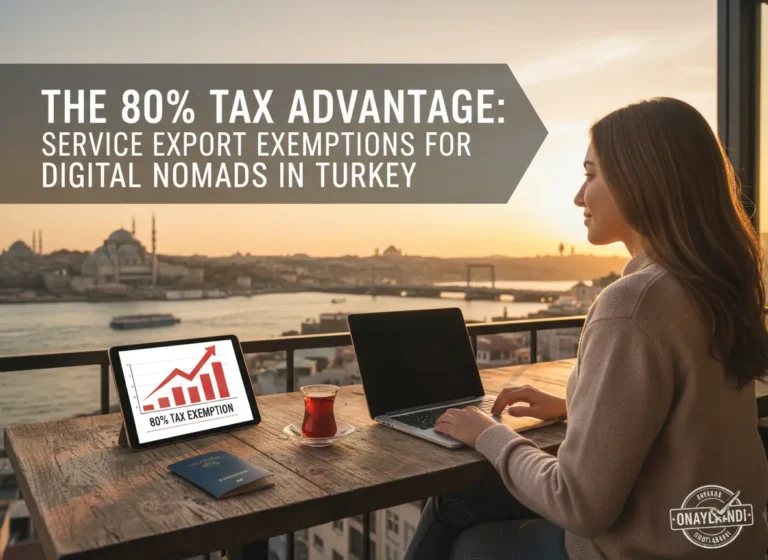
Türkiye applies 20% VAT as its standard rate, but financial transactions in crypto assets themselves are not currently treated as VAT-taxable supplies. The more interesting lever for Turkish operators is the service export exemption: software, design, engineering, and data services invoiced to foreign clients and utilized abroad are zero-rated for VAT and qualify for an 80% income tax exemption on the earnings when foreign currency is repatriated. A Turkish company providing wallet SDKs, API access, or smart-contract development to international counterparties can therefore operate at a near-zero effective tax cost on that revenue line.
Licensing Cost and Substance: The Hidden Bill
Tax rates are only meaningful when measured against the cost of staying compliant. A VARA license in Dubai carries application fees ranging from AED 40,000 to AED 100,000 depending on category, annual supervision fees that scale with revenue, and minimum paid-up capital ranging from AED 1.5 million for a broker-dealer to AED 7.5 million for an exchange. Add Free Zone establishment costs, office leases meeting substance tests, and senior compliance and MLRO hires, and a fully operational exchange in Dubai routinely budgets USD 1–3 million in year-one regulatory and infrastructure spend.
Türkiye’s CMB framework requires a minimum paid-in capital of TRY 150 million for crypto asset service providers and TRY 500 million for exchanges (with additional own-funds floors that scale with trading volume), alongside detailed IT, custody, and internal-audit infrastructure. The licensing fee is materially lower than VARA, the human-capital cost is significantly cheaper, and operational overhead — office space, engineering salaries, legal services — runs at a fraction of UAE rates. For a domestically-focused exchange targeting Türkiye’s deep retail base, the total cost of compliance is competitive even before factoring in the tax differential.
Banking, Stablecoin Rails, and Capital Movement
A regime is only as good as the banks that operate within it. Dubai’s banking ecosystem is mature for crypto-adjacent business: several local and international banks (Mashreq, Emirates NBD, RAKBANK, and global players via DIFC branches) now onboard VARA-licensed entities, and dirham–stablecoin corridors are operational through licensed payment providers. Capital movement is unrestricted; dividends and management fees flow out freely.
Türkiye’s banking sector has historically been cautious with crypto operators, but Law No. 7518 has triggered a shift: licensed CMB-regulated VASPs can now open dedicated client-asset trust accounts at major Turkish banks, and several institutions have launched tailored treasury products for the sector. Capital movement is largely free for licensed entities, though larger cross-border transfers are subject to FX reporting under the Central Bank’s general regime. For founders running a multi-jurisdictional treasury, the practical workflow often combines a Türkiye operating company (for talent and retail reach) with a Dubai treasury or holding entity (for capital, dividends, and stablecoin custody).
Residency and Substance: Where the Founder Actually Lives
Personal residency drives where the founder’s own income is taxed, regardless of where the company is established. The UAE offers tax residency for individuals who spend 183 days per year in the country (or 90 days for those with a permanent home and economic ties), with a streamlined Tax Residency Certificate process and a Golden Visa route for investors and high-skill professionals. Combined with zero personal tax, this is the cleanest setup for a founder optimizing personal income.
Türkiye offers residency through real estate investment (USD 400,000 threshold for citizenship; lower for residence permits), through company ownership, and through the digital nomad visa launched in 2024. A founder who becomes a Turkish tax resident is taxed on worldwide income at progressive rates, but the 80% service-export exemption, the young entrepreneur incentive (under age 29), and the Technopark income exemption can collectively bring effective personal tax into the low single digits for technology-classified activity. The Turkish setup rewards founders who actively work within the regulated tech sector; the Dubai setup rewards founders who simply want zero personal tax with minimal structural friction.
The Strategic Calculus: Which Regime Fits Which Business
For a licensed exchange or custodian targeting Türkiye’s retail market, establishment in Türkiye under the CMB regime is effectively non-negotiable — the licensing perimeter requires it. The 25% corporate tax is offset by lower operating costs, deep liquidity, and the ability to channel software development through a Technopark structure for additional exemption.
For a global exchange, market maker, or DeFi protocol with no specific Turkish retail focus, Dubai under VARA remains the cleaner setup: 0% (or 9%) corporate tax in the Free Zone, zero personal tax, mature banking, and a regulator that has spent four years building an internationally-recognized framework.
For a founder running a software-heavy crypto venture — wallet infrastructure, on-chain analytics, compliance tooling, validator services — Türkiye’s Technopark regime combined with the 80% service-export exemption can produce an effective tax rate that rivals or beats Dubai, particularly once the cost of UAE substance is netted out.
For a treasury or family office holding crypto on its own account, Dubai’s zero personal and capital gains tax is the dominant choice, and most sophisticated founders pair this with an operational entity in another jurisdiction.
Conclusion: Structure Beats Slogans
The “crypto-friendly” label has become marketing collateral, but the real work happens at the level of entity structure, licensing perimeter, and personal residency. Türkiye in 2026 is a serious jurisdiction for licensed crypto operators, with a regulatory framework that has finally matured, a deep talent pool, and an incentive system that materially rewards technology-classified work. Dubai remains the global benchmark for low-tax crypto holding and exchange operations, with banking and regulatory infrastructure that few jurisdictions can match.
The right answer is rarely binary. The most efficient structures we design for clients combine the two: a Türkiye operating company that captures regional liquidity, software talent, and Technopark exemptions, paired with a Dubai holding or treasury entity that absorbs capital, dividends, and global counterparties. At IncorpTürkiye, we help founders model the after-tax cash flows of each setup, calibrate the licensing and substance requirements, and execute company formation in Türkiye and partner jurisdictions in a way that preserves optionality as the regulatory landscape continues to evolve.