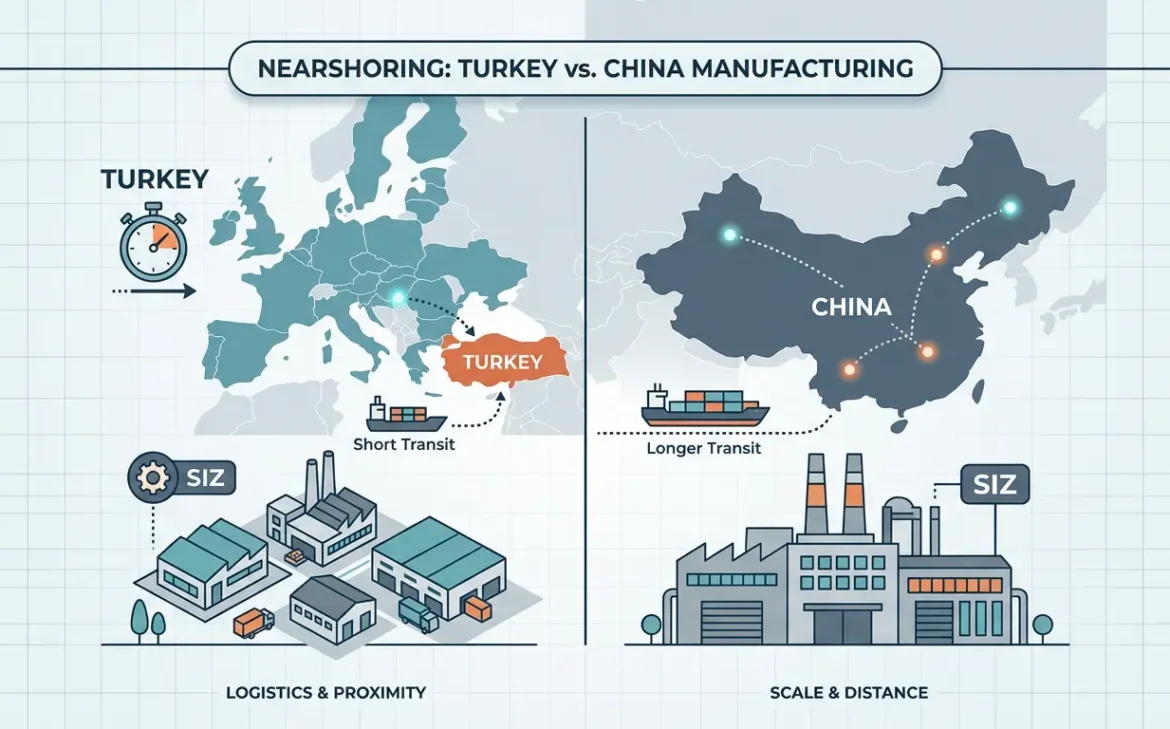
Turkey exports to over 200 markets. Its manufacturing base spans automotive, electronics, textiles, chemicals, and defence. Its geography puts it within a single trade corridor of Europe, the Middle East, Central Asia, and North Africa. And the data confirms what experienced investors have long understood: foreign direct investment in Turkey drives export growth — and export growth drives returns.
The Core Case: FDI and Export Growth Move Together in Turkey
The relationship between foreign investment and export performance in Turkey is not a marketing claim — it is measurable and statistically robust. Econometric analysis covering Turkey's trade and investment data from 1990 to 2018, using the UNCTAD-Eora Global Value Chain Database alongside TÜİK and World Bank data, confirms a clear and sustained finding: foreign direct investment is a significant positive driver of Turkey's export growth.
The analysis also finds a bidirectional causality between export growth and economic development in Turkey. Exports drive GDP expansion through job creation, industrial capacity growth, and innovation. Economic growth, in turn, strengthens Turkey's ability to produce higher-value goods that compete in global markets. For a foreign investor, this bidirectional relationship matters: entering Turkey is not simply a bet on a domestic market — it is a position in an economy with structural export momentum.
Turkey's Export Reach: Who Is Buying Turkish Goods
Turkey is not a single-market economy. Its export base is genuinely diversified across destination countries — a critical resilience factor for any investor whose returns depend on production or distribution through Turkey.
According to TÜİK (Turkish Statistical Institute) trade data for the 2013–2023 period, Turkey's top export destinations include:
| Export Destination | Share (2013) | Share (2023) | Trend |
|---|---|---|---|
| Germany | 9.8% | 9.4% | Stable — largest single destination |
| United States | 4.4% | 5.9% | Growing — significant upward shift |
| Iraq | Higher | Significant | Key MENA gateway |
| United Kingdom | Higher | Significant | Major European partner |
What this table reflects is a trade architecture that reaches deep into European markets while simultaneously maintaining strong positions across the Middle East. For a foreign investor producing in Turkey, this means access to the EU single market, growing US trade flows, and a natural gateway into MENA — from a single base of operations.
Global Value Chains: Turkey's Strategic Insertion Point
The concept of global value chains (GVCs) — the interconnected networks through which production, assembly, and distribution are split across multiple countries — is central to understanding Turkey's investment appeal. Turkey has been systematically building its GVC participation over decades, and the economic payoff is now measurable.
Econometric modelling confirms that Turkey's integration into global value chains has a significant and sustained positive impact on its export growth over the long run. Deeper participation in GVCs gives Turkish-based operations access to global markets, exposes them to technological advancements, and improves production efficiency — all of which directly benefit foreign investors operating from Turkey.
How GVC Participation Creates Value for Foreign Investors in Turkey
The technology transfer mechanism is particularly significant. When a foreign investor establishes operations in Turkey, they bring production methods, quality standards, and organisational practices that embed into the local supply chain. Toyota's manufacturing plant in Turkey is a well-documented example: it functions not simply as a production facility, but as a technology transfer node that has elevated the capacity of domestic Turkish suppliers across the automotive supply chain.
A similar dynamic plays out in electronics and defence. Foreign firms that establish manufacturing or R&D operations in Turkey do not operate in isolation — they plug into a supply ecosystem that is actively upgrading, and they benefit from that upgrade as it accelerates.
Turkey's Structural Advantages for Export-Oriented FDI
The investment case for Turkey is grounded in four structural characteristics that distinguish it from comparable emerging markets.
Geographic Position: One Hub, Three Markets
Turkey sits at the intersection of Europe, the Middle East, and Central Asia. This is not a rhetorical point — it translates directly into logistics economics. Production based in Turkey can reach the Balkans and Central Europe by road within two to three days. The Middle East and North Africa are accessible via established sea and air routes from Istanbul, Mersin, and Izmir. No comparable emerging market offers simultaneous proximity to all three of these demand zones.
Manufacturing Depth Across Multiple Sectors
Turkey is not a single-sector manufacturing economy. Its industrial base spans automotive, textiles, electronics, chemicals, food processing, machinery, and defence. This breadth means that foreign investors across a wide range of sectors can find existing supplier networks, workforce capability, and production infrastructure — rather than having to build supply chains from zero. For GVC integration specifically, this existing depth is a critical accelerant.
EU Customs Union and Broad Trade Agreement Coverage
Turkey has been in a Customs Union with the European Union since 1996 — meaning manufactured goods produced in Turkey enter EU markets without customs duties. Turkey has also signed free trade agreements with numerous countries across the Middle East, North Africa, and the Western Balkans. For a foreign investor producing in Turkey, this treaty network functions as a built-in market access infrastructure that would take years to replicate independently.
A State That Has Actively Built the Investment Environment
Since the 1980s, Turkey has implemented successive industrial development strategies designed to attract and retain foreign capital: investment incentive programmes, the creation of organised industrial zones and free trade zones, R&D and technology centre incentives, and export credit and financing mechanisms. These are not ad hoc concessions — they represent decades of policy accumulation aimed specifically at making Turkey competitive for export-oriented manufacturing investment.
The Sectors Where Turkey's GVC Position Is Strongest
GVC participation is not uniform across Turkey's economy. The gains from integration into global production networks have been most pronounced — and are most accessible to new foreign investors — in the following sectors:
The automotive sector deserves particular attention. Turkey is home to production facilities for Ford, Fiat, Toyota, Renault, Hyundai, and Mercedes-Benz, among others. The supplier ecosystem that has grown around these anchor manufacturers is one of the deepest in any emerging market — and it provides a ready-made network for new entrants in components, materials, and logistics.
A foreign automotive supplier looking to supply European OEMs, for example, can base operations in Turkey, collaborate with established Turkish suppliers who already meet European standards, and ship into the EU duty-free under the Customs Union. This is precisely the kind of value chain integration that the econometric data confirms drives Turkey's export growth — and that FDI catalyses.
What Turkey's Policy Framework Offers FDI
Turkey's formal investment environment has been progressively built to support foreign-led export growth. The policy tools available to foreign investors include:
- Investment incentive programmes offering tax reductions, VAT exemptions, and customs duty support for qualifying investments, administered through the Investment Office of the Presidency of Türkiye
- Organised Industrial Zones (OIZ) and Free Zones providing purpose-built manufacturing infrastructure with preferential tax and customs treatment
- R&D and Technology Centre incentives, including full income tax exemption on R&D expenditures and support for private sector technology development
- Export credit, financing, and insurance schemes through Türk Eximbank for export-oriented businesses
- National treatment under FDI Law No. 4875, guaranteeing foreign investors the same legal standing as domestic firms, with free profit repatriation and expropriation protection
The FDI-Export Relationship: What the Data Confirms
The long-run relationship between Turkey's global value chain participation, foreign direct investment, and export growth is statistically confirmed as a cointegrated system — meaning these variables move together over time and reinforce one another. This is not correlation; it reflects a structural interdependence embedded in Turkey's economic architecture.
For a foreign investor, the practical implication is significant. Investing in Turkey for export-oriented manufacturing is not a standalone bet on Turkish domestic demand — it is participation in a system where FDI, GVC integration, and export growth are mutually reinforcing. Capital and technology brought in by foreign investors raises production quality, which expands export reach, which grows the economy, which deepens the market and supply base for further investment.
The data also confirms that FDI's initial positive impact on exports is strongest when investment is directed toward technology transfer and production capacity development — rather than purely toward capital injection without operational substance. This means foreign investors who build real manufacturing or R&D presence in Turkey, rather than passive financial positions, are the ones who generate the most durable returns within this system.
Where Turkey Is Still Moving: The Upgrading Trajectory
Turkey's current position in global value chains is characterised by strength in mid-chain production — assembly, components, and intermediate manufacturing — but with a clear policy and investment direction toward higher-value-added output. This transition is already underway in automotive, defence, and electronics.
For foreign investors, this transition is an opportunity rather than a limitation. Entering Turkey now, while the GVC upgrading trajectory is in progress, means positioning ahead of the cost inflation that accompanies more mature manufacturing economies. Turkey still combines skilled labour with costs that are competitive relative to Western Europe — while the infrastructure, policy environment, and supply chain depth are already at a level that many lower-cost alternatives cannot match.
The strategic window for export-oriented manufacturing FDI in Turkey is a combination of existing depth and ongoing upgrading — a combination that is genuinely rare among economies at Turkey's scale.
Getting Established: What Export-Oriented Foreign Investors Need to Set Up
For a foreign investor entering Turkey for manufacturing or export-oriented operations, the company structure you establish shapes your access to investment incentives, your eligibility for organised industrial zone placement, your ability to participate in public procurement, and your standing with Turkish institutional partners.
Most export-oriented foreign manufacturers establish either a Limited Liability Company (Ltd. Şti.) — minimum capital TRY 50,000 under Turkish Commercial Code No. 6102 — or a Joint-Stock Company (A.Ş.) — minimum capital TRY 250,000 — depending on their scale, sector, and long-term plans for financing or public tenders. Larger investors targeting government-supported industrial programmes or seeking access to organised industrial zones typically require the A.Ş. structure and relevant sectoral certifications.
The incorporation decision is also the point at which your tax registration, incentive eligibility, employment structure, and operational permissions are established. Getting this right from the outset — with experienced local legal and financial counsel — avoids the restructuring costs that investors who set up quickly and informally consistently encounter later.
IncorpTurkiye handles the full company incorporation process for foreign investors — from entity selection and registration to tax setup, bank account opening, and investment incentive applications. We work with manufacturers, exporters, and sector-specific investors across Turkey.