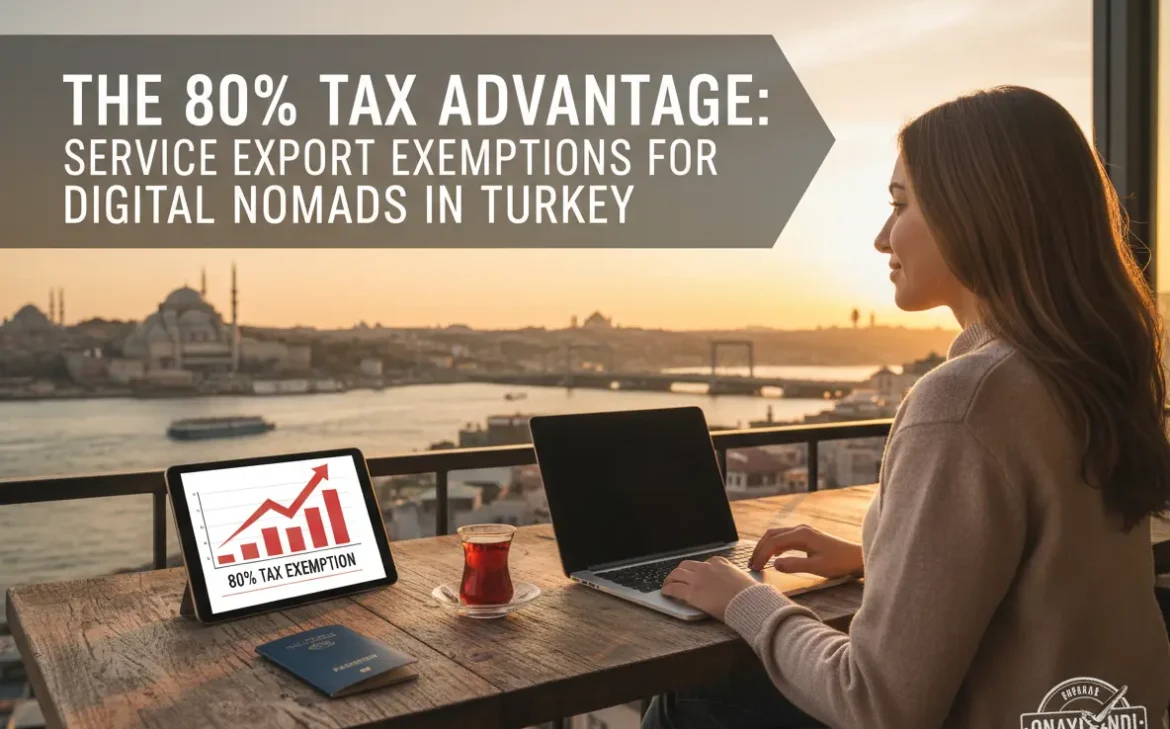
The 80% Tax Advantage: Service Export Exemptions for Digital Nomads in Turkey
The 80% Tax Advantage: Service Export Exemptions for Digital Nomads in Turkey Turkey has long been celebrated as a haven for Digital Nomads, offering a unique blend of Mediterranean lifestyle, rich history, and affordable living costs. However, the narrative is shifting. Beyond the allure of turquoise coasts and bustling bazaars, Turkey is rapidly emerging as a fiscal sanctuary for remote workers and service exporters. With recent amendments to the tax code, specifically aiming to boost foreign currency inflows, the government has introduced one of the most generous tax incentives in the OECD. For software developers, designers, architects, and data analysts servicing clients abroad, the “Service Export Exemption” now offers a staggering tax advantage: the ability to exempt up to 80% of your earnings from income tax. This guide dissects the mechanics of this incentive, transforming Turkey from a mere travel destination into a strategic base for wealth preservation. The Evolution of the “Earnings Exemption” To understand the magnitude of this benefit, one must look at the legal framework rooted in the Income Tax Law (Gelir Vergisi Kanunu). Historically, Turkey offered a 50% earnings exemption for specific service sectors exporting their intellectual capital abroad. This meant that if you earned $100,000 from a client in London or New York, you were only taxed on $50,000. However, recognizing the changing dynamics of the global workforce and the country’s need for foreign currency, the legislation was significantly sweetened. Under the new regulations (specifically aligned with the amendments via Law No. 7491), the exemption rate has been elevated to 80%, provided certain repatriation conditions are met. This effectively means that for a qualifying Digital Nomad or freelancer, the taxable base is slashed to a mere fraction of the gross income, resulting in an effective tax rate that rivals many traditional low-tax jurisdictions like Dubai or Malta, but with the added benefit of a much lower cost of living. Who Qualifies? The “Eligible Services” Criteria This incentive is not a blanket tax cut for everyone; it is semantically targeted at “value-added” services. The law specifically lists the eligible professions. The primary beneficiaries are those in software development (yazılım), engineering, architecture, design (tasarım), medical reporting, bookkeeping, call center services, and data storage/analytics. For the Digital Nomad community, the definitions of “Software” and “Design” are particularly broad and inclusive. “Software” encompasses everything from backend coding and UI/UX design to system maintenance and licensing. “Design” covers industrial design, graphic design, and even fashion design. If your invoices describe services that fall within these technical or creative domains, and your client is located outside of Turkey, you are theoretically holding the key to this tax advantage. It is crucial, however, that the service is strictly defined. General “consultancy” or “management” services often fall into a grey area and are frequently excluded from this specific exemption, making the correct drafting of your service contracts and invoices a critical step in business setup in Turkey. The Core Condition: Service Utilization Abroad The golden rule of this incentive is the concept of “utilization abroad” (hizmetten yurtdışında yararlanılması). It is not enough for the client to be a foreign entity; the benefit of the service must be enjoyed outside of Turkey. For example, if you are a software developer writing code for a German company, and that code is used in Germany or sold to global customers, you qualify. However, if you are writing code for the Turkish branch of that German company, or if the software is intended for the Turkish market, the exemption is void. The invoice must be issued to a foreign address, the payment must originate from abroad, and the “intellectual output” must leave Turkish borders. This distinction is vital for compliance. The Turkish tax authorities (Revenue Administration) will look at the flow of the service to ensure it is a genuine export of labor and intellect. Unlocking the 80%: The Repatriation Requirement How do you jump from the standard 50% exemption to the supercharged 80%? The answer lies in “repatriation” (döviz getirme şartı). The government’s logic is simple: “We will give you a massive tax break, but you must bring the foreign currency into the Turkish banking system.” To qualify for the additional 30% deduction (bringing the total to 80%), the earnings derived from these export services must be transferred to a bank in Turkey. The regulations typically require that a significant portion (often the entirety of the declared income) be repatriated by the time the annual income tax return is due. This does not mean you must convert the money into Turkish Lira immediately—holding it in a foreign currency account is usually acceptable—but the funds must physically hit the Turkish financial system. For Digital Nomads who might use platforms like Wise or Payoneer, establishing a proper flow to a local business bank account is essential to document this repatriation and claim the full 80% deduction. The VAT Exemption: The Cherry on Top While income tax is a direct tax on profit, value-added tax (VAT—KDV) is a consumption tax. In domestic transactions in Turkey, freelancers must add 20% VAT to their invoices. However, strictly for service exports, the VAT rate is 0%. This is known as the “Full Exception” (Tam İstisna). Since the service is utilized abroad, it is not subject to Turkish VAT. This makes your pricing 20% more competitive compared to a local peer, or simply saves you the administrative headache of collecting and remitting VAT. Furthermore, because this is a “full exception,” you retain the right to claim back the VAT you paid on your business expenses (e.g., laptop purchases, office rent) from the tax office. This “VAT Refund” (KDV İadesi) mechanism can provide an additional cash flow injection, turning your operational expenses into refundable assets. Corporate vs. Sole Proprietorship: Structuring for the Benefit To utilize these incentives, you must be a registered taxpayer. You cannot claim this as a tourist on a visa. This brings us to the structure: Sole Proprietorship (Şahıs Şirketi) versus Limited Liability Company (LLC). For most individual Digital Nomads
Foreign Investment in Turkey, Global Expansion & Export from Turkey


