380 Albert St, Melbourne

Foreign Investment in Turkey

The Service Sector Gateway: Strategic Company Registration in Turkey for Global Agencies

In the 2026 global economy, the service sector has transcended physical borders, yet it remains anchored by the need for strategic regional bases. For global advertising agencies, software consultancies, and digital firms, The Service Sector Gateway is undoubtedly Turkey. As a bridge between the mature markets of Europe and the high-growth potential of the MENA region, Turkey offers more than just geographic proximity. It provides a sophisticated legal and fiscal environment that rewards high-value-added service exports. By aligning your company registration in Turkey with the country’s modern tax incentive frameworks, your agency can transform from a local service provider into a global powerhouse with optimized operational costs and a superior talent pool. The Fiscal Advantage: 80% Tax Deduction for Service Exports The most compelling reason for an agency’s company formation in Turkey is the aggressive tax incentive specifically designed for cross-border services. Under Article 10 of the Corporate Tax Law, companies providing services—such as software development, design, data analysis, and architectural consulting—to clients located exclusively outside of Turkey are eligible for an 80% deduction from their corporate tax base. This means that if your agency generates 100% of its revenue from international clients, only 20% of your net profit is subject to the standard corporate tax rate. In the 2026 fiscal environment, this effectively lowers your tax burden to a single-digit percentage, making Turkey one of the most tax-efficient “Service Hubs” in the world. When executing a company setup in Turkey, ensuring that your Articles of Association (AoA) are correctly coded to reflect these eligible service categories is the critical first step toward securing this multi-million dollar advantage. Talent Arbitrage and Operational Scalability Global agencies face a perpetual war for talent and rising overheads in hubs like London, New York, or Dubai. A strategic company registration in Turkey allows agencies to leverage “Talent Arbitrage.” Turkey boasts a massive, multilingual, and tech-savvy workforce that is deeply integrated into European design and engineering standards. The cost of operating a high-end creative or technical team in Istanbul or Ankara is significantly lower than in Western Europe, without sacrificing quality. This allows agencies to scale their production teams rapidly while maintaining high margins. Furthermore, the 2026 labor laws provide flexible remote-work frameworks, allowing your Turkish entity to employ top-tier talent from across the country while managing them through a centralized, compliant corporate structure. VAT-Exempt Revenue: Maximizing Global Cash Flow For global agencies, cash flow is the lifeblood of growth. One of the primary Turkey company registration advantages is the VAT (Value Added Tax) exemption on service exports. Services performed in Turkey but utilized abroad are not subject to the standard 20% VAT. This ensures that your agency’s invoices remain globally competitive while avoiding the complexities of VAT recovery in international transactions. Additionally, Turkey’s extensive network of Double Taxation Agreements (DTA) with over 80 countries ensures that your profits can be repatriated with minimal withholding tax friction. At IncorpTürkiye, we focus on the “Cash Flow Blueprint” during your company formation in Turkey, ensuring that your banking and invoicing structures are optimized to capture these exemptions from the very first transaction. Digital Sovereignty and Intellectual Property Protection In the service sector, your most valuable assets are your ideas and your data. Turkey’s intellectual property (IP) laws are fully harmonized with EU standards and the WIPO (World Intellectual Property Organization) framework. Whether you are registering trademarks for your agency or protecting proprietary software code, the legal system provides robust enforcement mechanisms. During the company setup in Turkey, we implement strict internal governance protocols and employment contracts that include IP assignment clauses, ensuring that all creative output generated by your Turkish team remains the exclusive property of the global parent company. This legal safeguarding is essential for agencies that handle sensitive client data or develop proprietary technology as part of their service offering. Conclusion: Orchestrating Global Growth from the Bosporus Turkey is no longer just a destination for manufacturing; it is the definitive Service Sector Gateway. By combining massive tax deductions with a high-caliber talent pool and strategic geographic access, Turkey offers global agencies a unique platform for sustainable, high-margin expansion. The 2026 landscape for company registration in Turkey is built for the agile, digital-first agency that demands both legal security and fiscal efficiency. At IncorpTürkiye, we don’t just register entities; we engineer global gateways. From navigating service export incentives to managing complex IP protections, we ensure that your Turkish agency is not just a branch, but a strategic engine for your global success.

Company Formation in Turkey, Foreign Investment in Turkey

The Bridge Between Continents: Why Turkey is the Ultimate Hub for Multi-Continental Supply Chains

The Bridge Between Continents: Why Turkey is the Ultimate Hub for Multi-Continental Supply Chains In the global trade reality of 2026, the concept of a “transit point” has been structurally replaced by the “global command center.” As traditional maritime routes face unprecedented systemic risks—from geopolitical bottlenecks in the Red Sea to the increasing climate-related constraints on the Panama Canal—Turkey has emerged not just as a geographic bridge, but as the primary stabilizer for multi-continental supply chains. The convergence of the Middle Corridor, the expansion of the “Development Road” from the Gulf, and the 2026 operationalization of the Syria-Jordan land route have collectively transformed Turkey into the definitive hub for goods moving between the world’s largest production centers in Asia and the most affluent consumer markets in Europe. For the global enterprise, company formation in Turkey is no longer a peripheral option; it is the strategic move to secure a resilient, high-speed gateway to three continents. The Resurrection of Overland Trade: The Middle Corridor Advantage The year 2026 marks the definitive shift toward land and rail-based alternatives to vulnerable sea lanes. The Middle Corridor, connecting China to Europe via Kazakhstan, the Caspian Sea, Azerbaijan, Georgia, and Turkey, has reduced transit times to as little as 15 days—effectively cutting the journey by nearly 2,000 kilometers compared to northern or southern maritime routes. This corridor is the backbone of the new Eurasian connectivity, where Turkey serves as the final and most critical link into the European rail network. Unlike the Northern Corridor, which has been hampered by regional sanctions, the Middle Corridor offers a secure, internationally recognized pathway. For the global manufacturer, this means that cargo transported along this route now takes just 18 days instead of the 35 to 45 days required by traditional ocean freight. By establishing a corporate presence in Turkey, businesses gain direct control over this high-velocity artery, insulating their supply chains from the volatility of international waters and ensuring a consistent flow of inventory that sea-freight simply cannot guarantee in the current climate. The Development Road and the Gulf Connection: A New Southern Artery A significant pillar of Turkey’s 2026 hub strategy is the Development Road Project, a $20 billion land and rail initiative spearheaded by Iraq, Turkey, Qatar, and the UAE. This corridor facilitates trade volumes from Iraq’s Grand Faw Port directly through Turkey and into Europe, effectively bypassing the strategic straits that have historically led to dangerous bottlenecks in global supply chains. The Development Road is expected to cut shipping time from Asia to Europe from 33 days to approximately 15 days, reducing logistics costs by up to 40%. For a company incorporated in Turkey, this provides a dual-axis advantage: the ability to source raw materials from the East through the Middle Corridor while simultaneously accessing the energy-rich and rapidly growing markets of the Gulf through the Development Road. Turkey is no longer just a transit state; it is a multidimensional logistics and energy superpower that integrates 21 different countries into a single, Turkey-centered trade network. Multimodal Excellence: Integrating Sea, Rail, and Air Infrastructure Turkey’s transformation into a multi-continental hub is supported by a massive 2026 infrastructure program that has expanded its railway network to over 14,400 kilometers. The Ministry of Transport’s focus on port-rail connectivity—extending to major hubs like Mersin, Filyos, and Izmir—allows for a seamless multimodal transition that is unique in the EMEA region. The Filyos Port and the Black Sea Gateway Filyos Port, now operational with a capacity of 25 million tons per year, serves as Turkey’s “Northern Gateway,” linking the industrial heartland of Anatolia to the Black Sea and beyond. The integration of the Filyos Free Zone and Industrial Park provides a specialized environment where manufacturing and logistics are physically unified. This infrastructure allows for “Total Value” logistics, where speed is matched by digital transparency and administrative efficiency. Istanbul Airport: The Global Air Cargo Pivot The role of Istanbul Airport cannot be overstated. As a global air cargo leader, iGA provides the “express” layer for high-value trade, connecting to over 300 destinations. The ability to move high-precision electronics or pharmaceutical products from a Turkish factory to a European distributor in under 24 hours is an operational luxury that translates into significant capital efficiency. When a company incorporates in Turkey, it inherits an infrastructure designed for real-time asset management across diverse geographies. The Nearshoring Magnet: Proximity and Industrial Quality The strategic allure of Turkey in 2026 is deeply tied to the “Nearshoring” trend, as European firms seek to de-risk their supply chains by moving production closer to home. Turkey offers a high-precision industrial base that meets the most rigorous EU quality and environmental standards (ISO, CE, and REACH compliance). This proximity allows for “same-day” managerial oversight and “72-hour” terrestrial delivery to the heart of Europe. According to 2025-2026 trade statistics, Turkey’s exports have hit record highs, with annualized figures exceeding $269 billion. This surge is driven by Turkey’s ability to provide a “Just-in-Time” (JIT) production model that East Asian competitors cannot replicate due to the geographic distance. Manufacturing in Turkey is no longer just about geographic position; it is about being part of a stable, high-tech industrial ecosystem that offers the flexibility of regional production combined with the reach of a global trade powerhouse. Digital Governance and 2026 Logistics Efficiency The “soft” infrastructure of Turkey has also seen a revolution. The 2026 Logistics Performance Index (LPI) rankings reflect Turkey’s commitment to digital governance, with systems like MERSIS and the National Electronic Notification System (UETS) streamlining customs and administrative procedures. For the international investor, this means that the movement of goods is accompanied by a transparent, paperless administrative process. The digital integration of Turkish ports with the European “Single Window” system ensures that customs clearance is no longer a bottleneck but a facilitated transition. This transparency is a critical component of the “Bridge Between Continents” strategy, providing the level of trust and predictability required by institutional investors and global logistics firms. Conclusion: Securing a Position at the Global Pivot Point The 2026 global

Company Formation in Turkey, Foreign Investment in Turkey, Global Expansion & Export from Turkey

Green Energy Investment Incentives: How to Benefit from Turkey’s HIT-30 Strategic Support Program

Green Energy Investment Incentives: How to Benefit from Turkey’s HIT-30 Strategic Support Program In the shifting landscape of global industrial policy in 2026, Turkey has introduced its most ambitious fiscal instrument to date: the HIT-30 Strategic Support Program. This $30 billion initiative is specifically engineered to transition Turkey from a technology consumer to a global production hub for green energy hardware. For international investors, “HIT-30” represents a comprehensive de-risking mechanism, offering tailor-made support packages for high-scale investments in solar cells, wind turbines, and next-generation battery storage. By aligning company formation in Turkey with this project-based incentive model, global capital can secure a decisive competitive advantage in the EMEA region’s green transition. The Architecture of HIT-30: Project-Based Incentives for Green Tech The fundamental strength of the HIT-30 program lies in its move away from generic regional supports toward a highly specialized “Project-Based” framework. This system treats each investment of at least 1 billion TL as a unique strategic asset, allowing the Ministry of Industry and Technology to negotiate bespoke incentive packages. In the 2026 energy climate, this is particularly vital for manufacturers of solar wafers, wind turbine components, and green hydrogen electrolyzers. The program provides direct grants that can cover up to 25% of the total fixed investment cost, combined with corporate tax reductions that effectively lower the tax burden to as little as 2% for qualified green-tech projects. Beyond direct financial injections, HIT-30 offers unparalleled infrastructure and operational support. Investors benefit from specialized land allocations in strategic industrial zones, where the government facilitates “plug-and-play” setups including pre-installed energy and fiber-optic connections. Furthermore, the program addresses the high energy costs of manufacturing by offering a 50% energy bill subsidy for a specified duration, ensuring that operational overheads remain competitive during the critical ramp-up phase. This multi-layered support ensures that the capital-intensive nature of green energy production is offset by robust state participation. Strategic Priority: The $4.5 Billion Battery and Storage Call As of March 2026, the HIT-30 program has placed a significant premium on energy storage technologies, allocating $4.5 billion specifically to battery cell and component manufacturing. The goal is to reach a domestic capacity of 80 GWh by 2030. For a multinational firm, company registration in Turkey within this sector provides access to grants of up to $6,000 per megawatt-hour. This strategic focus is designed to integrate Turkey into the global electric vehicle (EV) and renewable grid-storage supply chains, offering manufacturers a secure terrestrial gateway to the European Union market under the Customs Union framework. Navigating the 2026 HIT-30 Application Landscape Securing support under the HIT-30 program is a high-level regulatory exercise that requires more than standard administrative filings. At IncorpTürkiye, we specialize in the technical and legal coordination required to qualify for these project-based decrees. The application process demands a sophisticated feasibility report that demonstrates technical competence, financial capability, and the project’s long-term contribution to Turkey’s technological independence. By structuring your legal entity and investment proposal to meet the rigorous criteria of the Industrialization Executive Committee, we ensure your venture is positioned for maximum grant eligibility and rapid operational activation. Conclusion: Securing the Green Future of 2030 The HIT-30 program transforms the Turkish industrial landscape into a fortified environment for sustainable growth. By providing $30 billion in dedicated resources, Turkey is inviting global investors to not only build facilities but to architect the future of the green energy economy. For the forward-thinking enterprise, the current 2026 window represents the optimal time to engage with these incentives, securing prime land and high-tier grants before the program’s 2030 capacity targets are reached. In the new reality of green manufacturing, being at the center of the HIT-30 ecosystem is the definitive strategy for regional leadership.

Foreign Investment in Turkey, Global Expansion & Export from Turkey

Setting Up a Regional Headquarters (HQ) in Turkey

Setting Up a Regional Headquarters (HQ) in Turkey: Legal Structures and Operational Benefits In 2026, the global corporate landscape has moved beyond traditional centralized models, favoring regional hubs that offer both tax efficiency and logistical agility. For multinational enterprises, setting up a regional headquarters (HQ) in Turkey is no longer just a geographical choice—it is a strategic play to govern operations across the EMEA (Europe, Middle East, and Africa) region from a single, high-connectivity jurisdiction. Under the Turkish Commercial Code (TCC) and the Foreign Direct Investment (FDI) Law, Turkey provides a dedicated framework for regional management centers. However, the legal structure chosen for a regional HQ dictates its operational scope, tax treatment, and its ability to engage in commercial transactions. Navigating this architecture requires a deep understanding of the distinction between “Representative” units and “Commercial” hubs. Selecting the Legal Architecture for Your Regional HQ The first step in company formation in Turkey for a regional hub is deciding between a Liaison Office (Representative) and a Regional Management Center (Commercial). This decision defines the legal “DNA” of your operation. The Liaison Office (Representative Hub) For companies that wish to coordinate regional offices without generating direct revenue in Turkey, the Liaison Office (İrtibat Bürosu) remains a powerful tool. Governed by the Ministry of Industry and Technology, these offices are strictly prohibited from engaging in commercial activities. Their sole purpose is to gather information, conduct market research, and provide technical support to the parent company. The strategic advantage of this structure lies in its fiscal status: Liaison Offices are exempt from Corporate Income Tax (CIT), and the salaries of their employees—if paid in foreign currency from abroad—are exempt from Personal Income Tax. This makes it an ideal “Coordination Center” for regional directors who oversee multiple territories but do not execute sales within Turkey. The Regional Management Center (Commercial Hub) If the regional HQ is intended to manage contracts, issue invoices, or centralized regional procurement, a Joint Stock Company (JSC) or a Limited Liability Company (LLC) structure is required. This “Commercial Hub” functions as a full legal entity in Turkey. While subject to the standard 25% Corporate Tax rate (as of 2026), it allows the parent company to centralize its regional billing and profit-sharing. For large-scale HQs, the JSC is generally preferred due to its sophisticated governance model and the ability to issue different classes of shares for regional executives. Operational Benefits: The Strategic “Mid-Point” Advantage Istanbul has solidified its position in 2026 as the primary management hub for the EMEA region. The operational benefits of setting up a regional HQ in Turkey stem from a combination of infrastructure and human capital. Logistics and Executive Mobility The “4-Hour Flight Radius” is the most cited operational benefit. From Istanbul, regional managers can reach the major financial centers of Europe, the Middle East, and Central Asia within half a work day. This executive mobility is supported by Istanbul Airport’s non-stop connectivity to over 300 destinations. For a regional HQ, this means that crisis management, site visits, and regional summits can be executed with minimal downtime. Talent Pool and Nearshoring Turkey offers a unique talent proposition: a highly educated, multilingual workforce with deep experience in regional trade. Unlike Western European hubs, the cost of high-level management talent in Istanbul remains competitive, allowing regional HQs to scale their support teams (HR, Finance, IT) more efficiently. This has led to a surge in “Nearshoring,” where global firms move their back-office regional management from high-cost cities like London or Dubai to Istanbul. Tax Incentives and Financial Architecture While the standard CIT rate is 25%, the Turkish government offers specialized incentives for regional headquarters that contribute to the country’s “Hub” vision. Income Tax Exemptions for Regional Employees One of the most significant operational benefits is the income tax exemption for employees of companies that have received a “Regional Management Center” designation from the Ministry of Industry and Technology. To qualify, the HQ must manage at least five other countries’ operations. This incentive significantly reduces the gross salary cost for the employer while maintaining high net salaries for expatriate and local managers. The 80% Export Income Deduction For regional HQs that provide services (such as management, accounting, or technical support) to their parent companies or affiliates abroad, an 80% deduction on the corporate tax base is applicable. This means that if your Turkish HQ provides a management service to a branch in Germany, only 20% of the income derived from that service is subject to corporate tax, effectively lowering the tax burden to approximately 5%. Governance and Compliance Mandates Operating a regional HQ in Turkey comes with a responsibility for high-level corporate governance. Under the 2026 regulatory framework, regional hubs are often subject to stricter “Ultimate Beneficial Owner” (UBO) reporting and Anti-Money Laundering (AML) checks, especially when dealing with capital flows across the Middle East and Africa. The Role of Independent Audits Large-scale regional HQs (JSCs) that meet certain turnover or asset thresholds are required to undergo independent audits. This is not merely a burden; it is a signal to global stakeholders that the Turkish hub operates under the highest international standards. TepeLaw provides the necessary legal scaffolding to ensure that these governance mandates are integrated into the company’s internal bylaws from the first day of company formation in Turkey. Conclusion: Orchestrating Global Growth from Istanbul Setting up a regional HQ in Turkey is a move toward operational sovereignty. It allows a global firm to “shrink” the map, bringing the markets of three continents into a single manageable radius. Whether through the tax-exempt simplicity of a Liaison Office or the robust commercial power of a JSC management center, Turkey provides the legal and logistical tools necessary for regional dominance. At IncorpTürkiye, we specialize in the “Architecture of Entry.” We don’t just register your company; we design your regional presence to maximize tax deductions and operational agility. In the 2026 economy, the world’s most successful firms are those that have mastered the art of being “at the center.” Let us help you

Foreign Investment in Turkey, Global Expansion & Export from Turkey

Acquisition vs. Incorporation: Strategic Approaches to Company Formation in Turkey through M&A

Acquisition vs. Incorporation: Strategic Approaches to Company Formation in Turkey through M&A For any international investor, the dilemma of entering the Turkish market revolves around a critical strategic choice: building a brand-new operation from the ground up or acquiring an existing business entity. While the concept of company formation in Turkey may appear as a straightforward registration process on paper, it transforms into a sophisticated exercise in investment engineering when Mergers and Acquisitions (M&A) enter the equation. Greenfield investments—establishing a new legal entity—offer a pristine start, whereas market entry through M&A provides an unparalleled momentum in terms of speed and immediate market share. The Dual Nature of Market Entry: Evolution of Strategic Choices From a 2026 perspective, Turkey’s pivotal role in global supply chains is pushing investors toward more aggressive entry models. Establishing a new company allows an investor to design corporate culture and operational standards without compromise. In this “Greenfield” model, the investor assumes no historical legal or financial liabilities. However, this advantage of a “clean slate” is often balanced against the significant time costs involved in brand recognition, obtaining specific industry licenses, and recruiting a qualified local workforce from scratch. On the other hand, acquiring an existing operation (Acquisition) is essentially integrating a “living ecosystem” into one’s global portfolio. This path is often the only viable way to bypass months or years of licensing procedures in highly regulated sectors such as energy, fintech, or specialized manufacturing. Here, the investor does not just acquire a trade name; they take over an established customer base, existing relationships with local banks, and, most importantly, a workforce that already understands the nuances of the local market dynamics. The Complexity of Due Diligence in the Acquisition Process When the decision is made to establish a presence in Turkey through an existing entity, the most critical phase becomes the comprehensive due diligence process. Unlike a standard company formation where the registry primarily verifies shareholder identities and capital adequacy, an acquisition requires a “radiological” examination of the target company’s financial, legal, and operational past. Financial due diligence uncovers hidden tax liabilities and examines cash flow consistency over the previous years, while legal due diligence analyzes “Change of Control” clauses in existing contracts and evaluates potential risks related to labor law disputes. Operational due diligence evaluates the alignment of the target’s intellectual property rights, lease agreements, and technological infrastructure with the investor’s global standards. A failure in this phase could lead an investor to find themselves in the middle of complex legal battles instead of generating the expected returns. Consequently, in the context of an acquisition, consultancy shifts from mere registration services to a high-level “risk management” center. Share Purchase vs. Asset Purchase: Choosing the Legal Vehicle There are two primary legal avenues for establishing a structure in Turkey via acquisition: a Share Purchase and an Asset Purchase. In the Share Purchase model, the investor buys the shares of the target company, maintaining its legal personality as is. This method is highly efficient for operational continuity and the preservation of existing licenses; however, it also means the investor inherits all historical liabilities of the company. In the Asset Purchase model, the investor typically first proceeds with a new company formation in Turkey and then acquires only the desirable assets—such as machinery, customer lists, or real estate—from the target company. This method allows the investor to avoid the historical risks, such as debts or pending lawsuits, associated with the target entity. However, asset purchases may require the individual renegotiation of every contract, which can slow down operational speed. The choice between these two vehicles depends entirely on the “cleanliness” of the target company and the strategic importance of the assets being transferred. Regulatory Hurdles and the Competition Authority Investors pursuing a growth strategy through company acquisition in Turkey must navigate one of the most significant legal checkpoints: the Turkish Competition Authority. Once certain turnover thresholds are exceeded, official clearance is mandatory to ensure the transaction does not create a dominant market position. In 2026, the dynamics of the technology and retail sectors have led to even more rigorous scrutiny by the Authority. Skipping or mismanaging this stage can lead to multi-million lira administrative fines and the potential invalidation of the entire transaction. This represents a much heavier bureaucratic burden than a standard incorporation process. Conclusion: Balancing Speed with Security In conclusion, the strategy for corporate establishment in Turkey is not just about choosing a registration method; it is about balancing risk against opportunity. If the goal is to adapt rapidly to market dynamics and tap into an immediate cash flow, acquisition remains unrivaled. However, for investors who wish to maintain total control and avoid the shadows of a company’s past, starting from scratch through incorporation remains the safest harbor. At IncorpTurkey, we map out the financial and legal landscapes of both worlds, ensuring that our clients’ commercial presence in Turkey is built on a foundation of long-term security and growth.

Company Formation in Turkey, Foreign Investment in Turkey

Establishing a Payment Institution in Turkey: Central Bank Licensing and Legal Requirements

Establishing a Payment Institution in Turkey: Central Bank Licensing and Legal Requirements The global financial technology landscape is shifting, and Turkey has emerged as one of the most vibrant battlegrounds for innovation. With a young, unbanked population eager for digital solutions and a strategic location bridging Europe and Asia, the Turkish market offers immense potential for Fintech disruptors. However, unlike the “move fast and break things” era of early Silicon Valley, the Turkish Fintech ecosystem is built on a bedrock of stringent regulation. For international investors, business setup in Turkey in the payment services sector is not merely a commercial incorporation; it is a complex regulatory marathon governed by the Central Bank of the Republic of Turkey (CBRT). Understanding the nuances of Law No. 6493 (The Law on Payment and Securities Settlement Systems, Payment Services and Electronic Money Institutions) is the first step in Payment Institution License Turkey journey. This guide serves as a strategic blueprint for establishing a licensed Payment Institution (PI) or Electronic Money Institution (EMI) in Turkey, dissecting the capital requirements, technological mandates, and the dual-stage licensing process that defines market entry. The Regulatory Architect: From BRSA to CBRT Historically, the Banking Regulation and Supervision Agency (BRSA) held the keys to the kingdom. However, a pivotal shift in the regulatory framework transferred this authority entirely to the Central Bank of the Republic of Turkey (CBRT). This move signaled a semantic and practical change: payment services are no longer just “banking-adjacent” activities; they are central components of the national monetary stability. Consequently, any foreign entity looking to register a company in Turkey with the intent of processing payments, issuing e-money, or acting as a digital gateway must navigate the CBRT’s rigor. This transition has streamlined supervision but also raised the bar for compliance, particularly regarding information systems and fund protection. Corporate Structure and Shareholding Eligibility Before approaching the regulator, the corporate vehicle must be perfectly aligned with statutory requirements. A standard Limited Liability Company (LLC) is insufficient for this tier of operation. The law mandates that a Payment Institution must be established as a Joint Stock Company (JSC – Anonim Şirket). This distinction is critical because JSCs offer a more robust governance structure, including a General Assembly and a Board of Directors, which the regulator demands for accountability. Furthermore, the shareholding structure is subject to a “transparent and open” test. All share certificates must be “registered” (nama yazılı) rather than “bearer” shares, ensuring that the Ultimate Beneficial Owners (UBO) are always identifiable. The CBRT conducts a deep-dive background check on any shareholder holding ten percent or more of the capital. These individuals must meet specific “fit and proper” criteria, similar to those required for bank founders. They must be free of bankruptcy history and serious criminal records, particularly those involving financial crimes, fraud, or tax evasion. This is where the initial company formation in Turkey intersects heavily with due diligence; a single red flag in a shareholder’s history can derail the entire license application. The Financial Pillar: Minimum Capital and Equity Fintech is capital intensive, and Turkish regulations reflect this reality to ensure system stability. The “entry ticket” is the minimum paid-in capital requirement, which must be fully paid in cash—not in kind—before the application. These figures are subject to annual revaluation based on the inflation rates and specific communiqués issued by the CBRT. As of the latest regulatory updates approaching the 2025-2026 period, the capital thresholds have been segmented based on the complexity of the service. For a standard Payment Institution acting as a gateway (intermediating fund transfers or acquiring transactions), the minimum equity requirement has seen significant upward revisions, currently hovering around the 30 Million TRY mark (subject to official gazette updates). For Electronic Money Institutions (EMIs) that issue digital wallets or prepaid cards, the threshold is considerably higher, reflecting the increased risk of holding customer funds. It is imperative to consult with IncorpTurkey for the exact, real-time figure on the day of your application, as these numbers are dynamic. Crucially, this capital must be free of any collusion or fictitious transactions; the regulator traces the “source of funds” to ensure it is clean capital. The Dual-Stage Licensing Process Obtaining a license is not a single administrative act; it is a two-phase process that tests both the theoretical and practical readiness of the applicant. Phase 1: The Establishment Permit The first hurdle is obtaining the “Establishment Permit.” In this stage, the investor submits a comprehensive dossier to the CBRT, including the draft Articles of Association, a detailed three-year business plan, and projected financials. The business plan must be more than a pitch deck; it must semantically demonstrate how the company will generate revenue while complying with Turkish laws. The regulator evaluates the feasibility of the model and the background of the founders. Only after receiving this permit can the investor formally register a company in Turkey at the Trade Registry with the title “Payment Institution” or “Electronic Money Institution.” Phase 2: The Operating License Incorporation is not authorization. Once the company is legally formed, it enters the second phase: the “Operating License” (Activity Permit). This is the audit phase. The company must build its physical and digital infrastructure, hire key personnel (including a General Manager and internal control staff), and establish its IT systems. The CBRT will not grant the final license until it is satisfied that the company can securely process transactions. This phase typically involves an on-site inspection. Information Systems and Data Localization Perhaps the most technically demanding aspect of Law No. 6493 is the requirement for Information Systems compliance. Turkey maintains a strict “Data Localization” policy for financial data. The primary and secondary systems used to process payment data must be physically located within the borders of Turkey. Relying solely on a global cloud provider hosted in Dublin or Frankfurt is not compliant. The applicant must undergo a rigorous “Information Systems Audit” conducted by independent audit firms authorized by the regulator. This audit verifies the security, redundancy, and business continuity plans of

Company Formation in Turkey, Foreign Investment in Turkey

The 80% Tax Advantage: Service Export Exemptions for Digital Nomads in Turkey

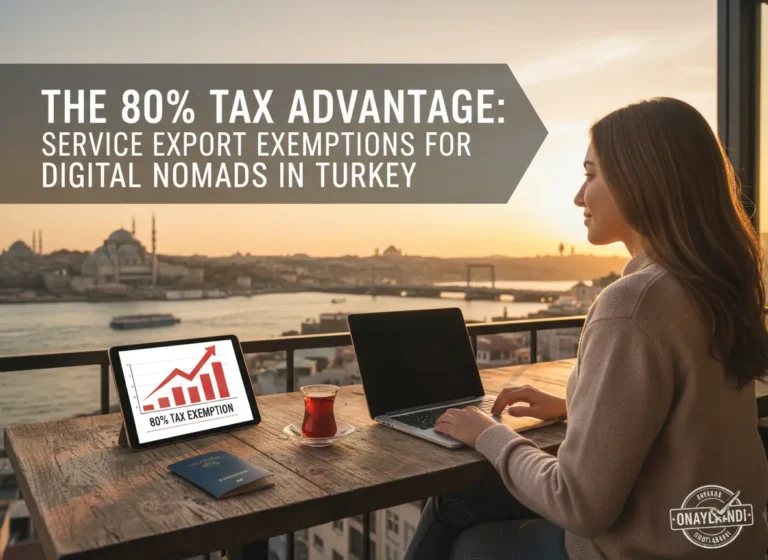
The 80% Tax Advantage: Service Export Exemptions for Digital Nomads in Turkey Turkey has long been celebrated as a haven for Digital Nomads, offering a unique blend of Mediterranean lifestyle, rich history, and affordable living costs. However, the narrative is shifting. Beyond the allure of turquoise coasts and bustling bazaars, Turkey is rapidly emerging as a fiscal sanctuary for remote workers and service exporters. With recent amendments to the tax code, specifically aiming to boost foreign currency inflows, the government has introduced one of the most generous tax incentives in the OECD. For software developers, designers, architects, and data analysts servicing clients abroad, the “Service Export Exemption” now offers a staggering tax advantage: the ability to exempt up to 80% of your earnings from income tax. This guide dissects the mechanics of this incentive, transforming Turkey from a mere travel destination into a strategic base for wealth preservation. The Evolution of the “Earnings Exemption” To understand the magnitude of this benefit, one must look at the legal framework rooted in the Income Tax Law (Gelir Vergisi Kanunu). Historically, Turkey offered a 50% earnings exemption for specific service sectors exporting their intellectual capital abroad. This meant that if you earned $100,000 from a client in London or New York, you were only taxed on $50,000. However, recognizing the changing dynamics of the global workforce and the country’s need for foreign currency, the legislation was significantly sweetened. Under the new regulations (specifically aligned with the amendments via Law No. 7491), the exemption rate has been elevated to 80%, provided certain repatriation conditions are met. This effectively means that for a qualifying Digital Nomad or freelancer, the taxable base is slashed to a mere fraction of the gross income, resulting in an effective tax rate that rivals many traditional low-tax jurisdictions like Dubai or Malta, but with the added benefit of a much lower cost of living. Who Qualifies? The “Eligible Services” Criteria This incentive is not a blanket tax cut for everyone; it is semantically targeted at “value-added” services. The law specifically lists the eligible professions. The primary beneficiaries are those in software development (yazılım), engineering, architecture, design (tasarım), medical reporting, bookkeeping, call center services, and data storage/analytics. For the Digital Nomad community, the definitions of “Software” and “Design” are particularly broad and inclusive. “Software” encompasses everything from backend coding and UI/UX design to system maintenance and licensing. “Design” covers industrial design, graphic design, and even fashion design. If your invoices describe services that fall within these technical or creative domains, and your client is located outside of Turkey, you are theoretically holding the key to this tax advantage. It is crucial, however, that the service is strictly defined. General “consultancy” or “management” services often fall into a grey area and are frequently excluded from this specific exemption, making the correct drafting of your service contracts and invoices a critical step in business setup in Turkey. The Core Condition: Service Utilization Abroad The golden rule of this incentive is the concept of “utilization abroad” (hizmetten yurtdışında yararlanılması). It is not enough for the client to be a foreign entity; the benefit of the service must be enjoyed outside of Turkey. For example, if you are a software developer writing code for a German company, and that code is used in Germany or sold to global customers, you qualify. However, if you are writing code for the Turkish branch of that German company, or if the software is intended for the Turkish market, the exemption is void. The invoice must be issued to a foreign address, the payment must originate from abroad, and the “intellectual output” must leave Turkish borders. This distinction is vital for compliance. The Turkish tax authorities (Revenue Administration) will look at the flow of the service to ensure it is a genuine export of labor and intellect. Unlocking the 80%: The Repatriation Requirement How do you jump from the standard 50% exemption to the supercharged 80%? The answer lies in “repatriation” (döviz getirme şartı). The government’s logic is simple: “We will give you a massive tax break, but you must bring the foreign currency into the Turkish banking system.” To qualify for the additional 30% deduction (bringing the total to 80%), the earnings derived from these export services must be transferred to a bank in Turkey. The regulations typically require that a significant portion (often the entirety of the declared income) be repatriated by the time the annual income tax return is due. This does not mean you must convert the money into Turkish Lira immediately—holding it in a foreign currency account is usually acceptable—but the funds must physically hit the Turkish financial system. For Digital Nomads who might use platforms like Wise or Payoneer, establishing a proper flow to a local business bank account is essential to document this repatriation and claim the full 80% deduction. The VAT Exemption: The Cherry on Top While income tax is a direct tax on profit, value-added tax (VAT—KDV) is a consumption tax. In domestic transactions in Turkey, freelancers must add 20% VAT to their invoices. However, strictly for service exports, the VAT rate is 0%. This is known as the “Full Exception” (Tam İstisna). Since the service is utilized abroad, it is not subject to Turkish VAT. This makes your pricing 20% more competitive compared to a local peer, or simply saves you the administrative headache of collecting and remitting VAT. Furthermore, because this is a “full exception,” you retain the right to claim back the VAT you paid on your business expenses (e.g., laptop purchases, office rent) from the tax office. This “VAT Refund” (KDV İadesi) mechanism can provide an additional cash flow injection, turning your operational expenses into refundable assets. Corporate vs. Sole Proprietorship: Structuring for the Benefit To utilize these incentives, you must be a registered taxpayer. You cannot claim this as a tourist on a visa. This brings us to the structure: Sole Proprietorship (Şahıs Şirketi) versus Limited Liability Company (LLC). For most individual Digital Nomads

Foreign Investment in Turkey, Global Expansion & Export from Turkey

The Financial Realities of Business Setup in Turkey: Taxes, Fees, and Capital

The Financial Realities of Business Setup in Turkey: Taxes, Fees, and Capital Embarking on the journey of business setup in Turkey is an investment in future growth, offering access to a bustling domestic market and a strategic export hub. However, for international entrepreneurs, the excitement of expansion is often tempered by the practical need for financial clarity. Understanding the monetary landscape is just as critical as understanding the legal one. While Turkey offers a highly competitive cost structure compared to Western Europe or the Gulf Cooperation Council (GCC) countries, the financial ecosystem consists of various layers—from initial state fees to ongoing fiscal obligations. This guide aims to demystify the financial realities of establishing a company in Turkey, providing a transparent, detailed breakdown of taxes, fees, and capital requirements for the forward-thinking investor. The Cost Structure of Pre-Incorporation Before a single document is filed with the Turkish Trade Registry, there are preliminary costs associated with preparing the legal groundwork. These are often categorized as “legalization expenses.” Since the majority of foreign investors choose to register a company in Turkey remotely, the process typically begins in their home country. The preparation of the Power of Attorney and the translation of passports involves notary fees and apostille charges. These costs vary depending on the investor’s country of residence, but they are the first financial step in the process. Once these documents arrive in Turkey, they must be translated by a sworn translator and notarized by a Turkish notary public. This semantic distinction between a “translator” and a “sworn translator” is important; only documents certified by the latter are accepted by state authorities, and their fees reflect this official capacity. Furthermore, the drafting of the Articles of Association represents a core component of the initial financial outlay. This constitutional document, which outlines the company’s scope, management, and capital, attracts a specific drafting fee. While digital systems like MERSIS have streamlined the submission, professional consultancy fees for correctly categorizing your business activity (NACE codes) and drafting a robust agreement are a necessary investment. Cutting corners at this stage often leads to costly amendments later, making professional company formation services in Turkey a cost-effective safeguard in the long run. Understanding State Fees and Trade Registry Expenses When the official application is made to the Trade Registry Office, several statutory fees become payable. These are fixed government charges and are generally uniform across the country, though they may vary slightly depending on the length of the Articles of Association. The primary cost here is the Trade Registry fee, which covers the registration and the subsequent announcement in the Turkish Trade Registry Gazette. This publication is legally mandatory as it serves as the public declaration of your company’s existence to third parties. In addition to the registration fee, there is a specific levy known as the “Competition Authority Share.” By law, a small percentage—currently calculated as four ten-thousandths (0.04%) of the company’s committed capital—must be deposited into the account of the Competition Authority. This payment is a prerequisite for registration. While the amount itself is often nominal for small businesses, it is a strict procedural requirement. Receipt of this payment must be presented to the Trade Registry officials; without it, the company incorporation in Turkey cannot proceed. Capital Requirements: LLC vs. JSC A major financial consideration for any investor is the minimum capital requirement. This is the amount of money you must commit to the company to give it financial life. For a Limited Liability Company (LLC), which is the most common structure for business setup in Turkey, the minimum capital threshold is subject to periodic updates by the Ministry of Trade to keep pace with economic conditions. Investors should always verify the most current thresholds with their legal advisors before proceeding. It is crucial to understand that this capital is not a “fee” paid to the government; it is your company’s operating money, available for use in business activities. The timing of the capital deposit also differs by company type. For a Joint Stock Company (JSC), at least twenty-five percent of the subscribed capital must be blocked in a bank account prior to registration. This funds blockage is released for company use immediately after the company is registered and the circular of signature is issued. However, for the LLC structure, the regulation is more flexible. In most cases, the capital does not need to be blocked beforehand. Shareholders can commit to paying the capital within twenty-four months following the registration. This flexibility significantly lowers the initial cash-flow barrier for startups looking to register a company in Turkey, allowing them to allocate early funds to product development or marketing rather than locking it in a bank account. The Ongoing Cost of Professional Services Once the company is formed, the financial focus shifts from setup costs to operational maintenance. Turkish law mandates that every company, regardless of its size or activity level, must retain the services of a Certified Public Accountant (CPA) or a financial advisor. Unlike in some jurisdictions where self-reporting is permitted, Turkey requires tax returns to be submitted by an authorized professional. The monthly fees for these accounting services vary based on the volume of invoices and the complexity of the business, but they are a fixed monthly overhead that must be factored into the budget. Additionally, if the company does not rent a physical office, it will incur costs for a Virtual Office address. For many foreign investors, the Virtual Office is a financial savior. It provides a legal address for notification and tax inspection purposes at a fraction of the cost of a physical lease. This service typically includes mail handling and answering services. Using a Virtual Office for company formation in Turkey is entirely legal and is a strategic way to minimize fixed overheads, especially in the early stages of market entry. Decoding the Tax System: Corporate Income Tax The most significant fiscal obligation for any successful business is the Corporate Income Tax. Turkey’s corporate tax regime is competitive and transparent. The

Company Formation in Turkey, Foreign Investment in Turkey

How Foreign Entrepreneurs Can Register a Company in Turkey Without Relocation

How Foreign Entrepreneurs Can Register a Company in Turkey Without Relocation Turkey has become one of the most accessible countries for foreign entrepreneurs who want to establish a business without physically relocating. Thanks to flexible commercial regulations, remote procedures, and investor-friendly policies, company formation in Turkey can now be completed entirely from abroad. For international founders looking to enter a strategic market connecting Europe, Asia, and the Middle East, Turkey offers a practical and legally secure path to incorporation without residency requirements. Is Physical Presence Required to Register a Company in Turkey? One of the most common concerns among foreign investors is whether they must travel to Turkey to complete the incorporation process. Under current regulations, registering a company in Turkey does not require the shareholders or directors to be physically present in the country. Through notarized powers of attorney issued abroad and properly legalized documents, the entire business setup process can be handled remotely. This approach is particularly attractive for entrepreneurs managing multiple international operations or those seeking market entry without immediate relocation. Company incorporation in Turkey can be completed while the founders continue operating from their home country, allowing for a smooth and low-risk expansion strategy. Legal Representation Through Power of Attorney The cornerstone of remote company formation services in Turkey is the use of a legally valid power of attorney. Foreign entrepreneurs can authorize local professionals to act on their behalf for all incorporation-related procedures, including Trade Registry filings, tax registrations, and bank account coordination. Drafting and Legalizing the Power of Attorney The power of attorney must be issued in the entrepreneur’s home country and legalized either through an apostille or consular approval, depending on international agreements. Once translated into Turkish by a sworn translator and notarized, this document grants full legal authority to complete the company formation process in compliance with Turkish law. This legal mechanism ensures that foreign founders maintain full ownership and control of their company while delegating procedural responsibilities to local experts. Remote Company Formation Process in Turkey Registering a company in Turkey without relocation follows the same legal framework as local incorporations, with the only difference being document handling and representation. The process begins with selecting the appropriate company type, most commonly a Limited Liability Company, followed by the preparation of the Articles of Association in line with the Turkish Commercial Code. Once the documentation is finalized, the company is registered with the Turkish Trade Registry Office, granting it legal personality. Tax registration, Social Security setup, and statutory bookkeeping obligations are then completed without requiring the founder’s physical involvement. This structured process ensures transparency and compliance at every stage of business setup in Turkey. Bank Account Opening Without Residency Opening a corporate bank account is often perceived as the most challenging step for foreign-owned companies. While some banks may request additional documentation, it is possible to open a company bank account in Turkey without the shareholder residing in the country. This is typically achieved through pre-approved banks familiar with foreign investment structures. The capital contribution requirements are managed in parallel with the bank account setup, ensuring that company incorporation in Turkey proceeds without delays. With proper coordination, this step can be completed efficiently even when founders are located abroad. Tax Registration and Ongoing Compliance from Abroad Foreign entrepreneurs often worry about managing tax and accounting obligations remotely. Turkish regulations allow companies to fulfill all compliance requirements through authorized accountants and financial advisors. Corporate tax filings, VAT declarations, and payroll reporting can be handled entirely by local professionals while shareholders remain overseas. This system enables foreign-owned companies to operate legally and efficiently without creating an administrative burden for the founders. As a result, company formation services in Turkey are not limited by geography, making the country an attractive destination for international business expansion. When Residency or Business Visa Becomes Relevant While residency is not required for company registration, it may become relevant at later stages depending on the entrepreneur’s operational plans. If a founder wishes to actively manage the business from Turkey, open additional bank accounts, or apply for certain incentives, a business visa or residence permit may be beneficial. However, these considerations are strategic rather than mandatory. Many foreign entrepreneurs successfully operate Turkish companies long-term without relocating, relying on professional local support structures. Why Turkey Is Ideal for Remote Company Formation Turkey’s legal infrastructure, digitalized public systems, and openness to foreign investment make it one of the most practical countries for remote company incorporation. The ability to register a company in Turkey without relocation significantly lowers entry barriers while preserving full ownership rights and legal protection. IncorpTurkey specializes in enabling this remote setup model by aligning legal, financial, and administrative processes under a single coordinated structure. By eliminating the need for physical presence, IncorpTurkey allows entrepreneurs to access Turkey’s dynamic market efficiently, securely, and strategically.

Company Formation in Turkey, Foreign Investment in Turkey
Let’s Get You Started

Fill out the form and one of our experts will get in touch to guide you.